
In April 2023 we wrote about chaining abstractions by a meta-DSL. In November 2024 our About page still listed the build system and the network of transformations as remaining work. Both are released now — internally: genc³ and genc³wb are available to design partners, not yet as a public download.
What genc³ does. Each step from one abstraction to the next — a domain language to a model, a model to code, a binary frame to text — is one rule file that describes a syntax and its translation. A network file chains the steps. genc³ builds the network like a build system, and while the network stands, an edit is rebuilt only where it matters: each step re-parses and re-generates only what changed and passes the change on to the next step as an edit delta.
What a step can read and write. Text in UTF-8, ISO 8859-1 or Windows-1252, bits and octets, indentation-sensitive syntax; outputs as text or bit-level binary. Rules are written in their natural form: left-recursive rules, direct or indirect, are parsed as written, and ordered choice never gives an input two parses. Generator rules are statically typed.
The workbench. genc³wb shows the network as a graph while genc³ evaluates it. Open a step, edit its rule file or its input, and see its diagnostics and the outputs of the chain after every change — as text, hex or bits.
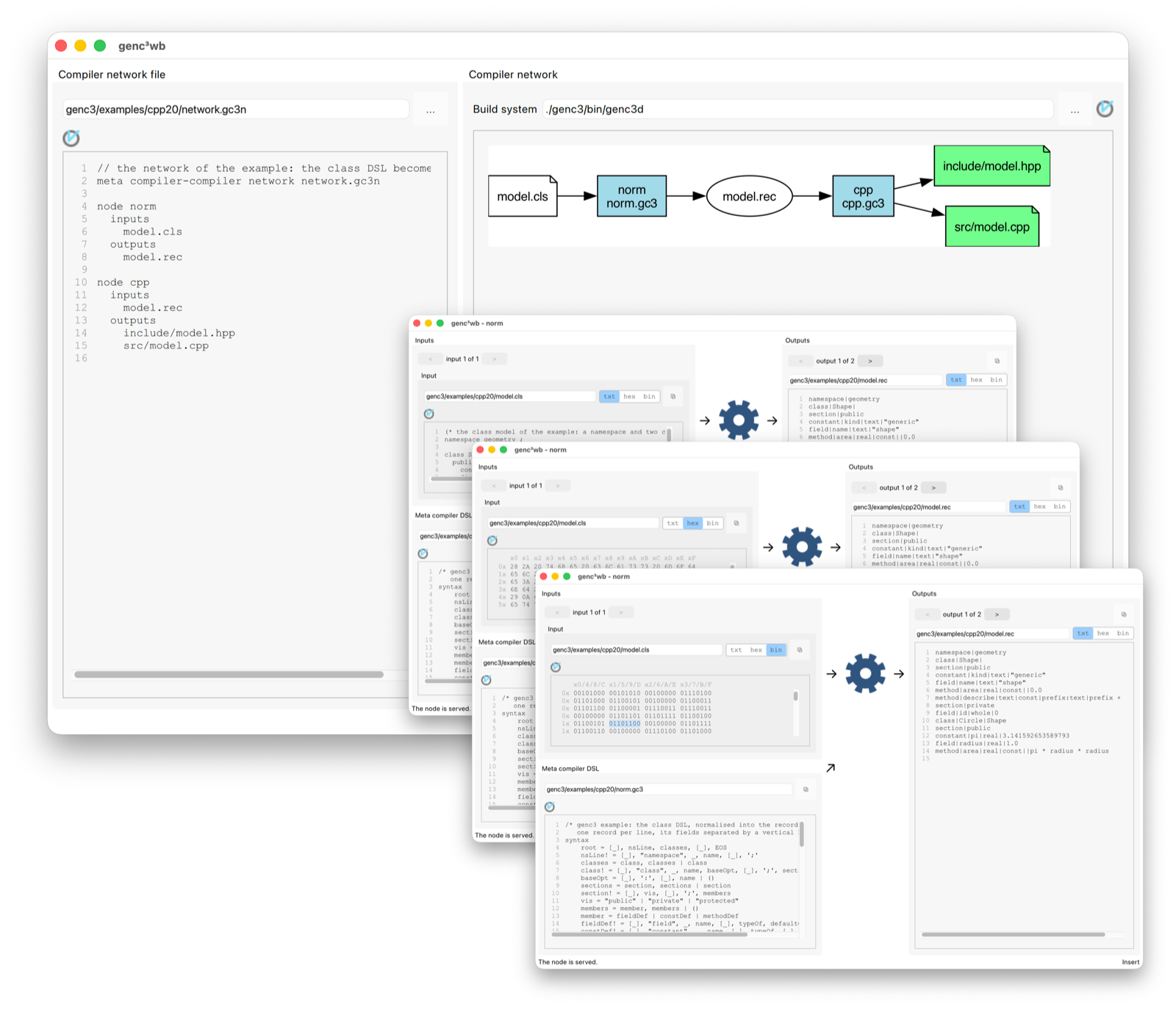
An example that ships with genc³: a small class language is normalised into a record form and rendered as two C++20 files that compile — three abstractions, two rule files, one network.
Why rule files when AI can write a parser in minutes? Because a rule file is the part you review, test, version and run again next year. AI assistance for writing rule files is planned; what it writes will be a rule file, not throwaway code.
What is next: builds for Linux and Windows, integration into existing IDEs, AI assistance for rule files and a marketplace for genc³ solutions — all planned. The notation may still change before 1.0.
Try it on your case. We are looking for a few design partners who translate formats or models in several steps. Contact form